


Choosing a hosting plan for your website can feel overwhelming. There are dozens of providers, each with different tiers, and it’s hard to know whether you’re overpaying for features you’ll never use or cutting corners that will come back to bite you. The good news? For most small websites, a basic hosting plan is all you need.
A basic hosting plan is the entry-level option offered by most web hosting companies. It’s designed for small websites that don’t need enterprise-level resources. But what exactly does “basic” include, and how do you know when it’s time to move up? That’s what this guide is all about.
Whether you’re launching your first website or reviewing what you’re currently paying for, understanding what a basic hosting plan offers (and what it doesn’t) will help you make a smarter decision with your budget.
What Is a Basic Hosting Plan?
A basic hosting plan is a shared hosting package that gives you the essentials to get a website online. “Shared” means your website sits on a server alongside other websites, sharing the server’s resources like processing power, memory, and storage. It’s the most affordable type of hosting and the most common starting point for new websites.
Almost every UK hosting company offers some form of basic plan. Names vary (Starter, Lite, Basic, Essential), but the concept is the same: a lower-cost package with enough resources to run a small website without breaking the bank.
In the UK, you can expect to pay anywhere from £3 to £8 per month for a basic hosting plan. Some providers advertise lower introductory prices, but watch out for renewal pricing that jumps significantly after the first term. A fair provider charges the same price at renewal as they do on day one.
How Shared Hosting Works
Think of shared hosting like renting a desk in a co-working space. You have your own workspace, but you share the building’s electricity, internet, and facilities with everyone else. If someone else is running heavy equipment, it might slow things down for you slightly, but for everyday work, it’s perfectly fine.
Modern shared hosting uses technology like CloudLinux and LVE containers to isolate each account, so one busy website can’t hog all the resources. This makes today’s shared hosting far more reliable than it was even five years ago.
What’s Typically Included in a Basic Hosting Plan
While every provider is slightly different, here’s what you should expect from a decent basic hosting plan in 2026:
Storage Space
Most basic plans offer between 5GB and 10GB of SSD storage. That’s more than enough for a standard small business website with 5-15 pages, a handful of blog posts, and a gallery of images. For context, a typical WordPress site uses around 1-2GB.
Bandwidth and Traffic
Bandwidth is the amount of data transferred between your server and your visitors. Basic plans typically offer either unmetered bandwidth or a set allowance of 50-100GB per month. For a small site getting a few hundred visitors a day, this is more than adequate.
Email Accounts
You’ll usually get between 1 and 10 email accounts (e.g., info@yourdomain.co.uk). Having a branded email address looks far more professional than using a Gmail or Hotmail address for your business.
SSL Certificate
A free SSL certificate (usually via Let’s Encrypt) is standard on virtually all hosting plans now. SSL encrypts the connection between your website and its visitors, and it’s essential for keeping your site secure and maintaining trust. Google also uses HTTPS as a ranking signal.
One-Click Installers
Most hosts include tools like Softaculous or Installatron that let you install WordPress, Joomla, or other platforms with a single click. No technical knowledge required.
Basic Support
Support is typically available via email or ticket system. Some providers include live chat. Response times vary, but you should expect a reply within a few hours at most.
Daily Backups
Some (not all) basic plans include automated daily backups. This is a feature worth checking for, as it means you can restore your site if something goes wrong. If your provider doesn’t include backups, it’s worth paying a little extra for a plan that does.
What’s Usually NOT Included in a Basic Hosting Plan
Knowing what’s left out is just as important as knowing what’s included. Here’s what basic plans typically don’t offer:
- Dedicated IP address – You’ll share an IP with other sites on the server. This is fine for most websites but can matter for certain SSL configurations or email deliverability.
- Premium or priority support – Phone support and priority queues are usually reserved for higher-tier plans.
- Advanced developer tools – Features like staging environments, Git integration, and SSH access are typically only on premium plans.
- High resource limits – CPU and RAM allocations are lower on basic plans, which means less headroom for traffic spikes.
- Built-in CDN or advanced caching – Content delivery networks and server-level caching (beyond what your CMS provides) are usually premium features.
- Malware scanning and removal – Automated security scanning tools like Imunify360 are sometimes only included on higher tiers.
None of these are dealbreakers for a small website. They become important as your site grows, handles more traffic, or requires more complex functionality.
Who Should Use Basic Hosting?
A basic hosting plan is ideal for:
Small Business Websites
If your website is a digital shopfront with 5-10 pages (Home, About, Services, Contact, etc.), a basic plan handles this comfortably. Most small business sites don’t need heavy resources because they’re primarily informational.
Personal Blogs
Running a blog with fewer than 1,000 visitors per month? Basic hosting is more than enough. Even with regular new posts, a blog is relatively lightweight in terms of server resources.
Portfolio Sites
Designers, photographers, and freelancers showing off their work don’t need enterprise hosting. A portfolio site with a gallery, some text, and a contact form runs perfectly on a basic plan.
Landing Pages
Single-page websites or campaign landing pages are minimal by nature. Basic hosting handles these without breaking a sweat.
Development and Testing Sites
If you’re building a website before it goes live, a basic plan is a cost-effective way to test things without committing to expensive hosting. You can always upgrade when you’re ready to launch properly.
When to Upgrade: Signs You’ve Outgrown Basic Hosting
Basic hosting is brilliant for getting started, but there are clear signs that it’s time to move up:
Your Site Is Loading Slowly
If your pages take more than 3 seconds to load, it could be a hosting issue. Slow load times hurt your Core Web Vitals scores and drive visitors away. Before upgrading, check whether the issue is your hosting or your site’s optimisation. Our guide on WordPress speed optimisation can help you rule out common causes.
Your Traffic Is Growing
Once you’re consistently getting more than 5,000 visitors per month, you’ll benefit from the extra resources that come with a premium or VPS plan. More traffic means more concurrent connections, more database queries, and more demand on the server.
You’re Running an Online Shop
E-commerce sites with WooCommerce or similar platforms need more power. Payment processing, product databases, and customer accounts all require additional CPU and memory. If you’re selling online, it’s worth investing in hosting that can keep up.
You’re Managing Multiple Websites
Basic plans usually cover a single website. If you need to host several sites, you’ll want a plan that supports multiple domains, or consider a reseller or VPS package.
You’re Hitting Resource Limits
If you’re getting “508 Resource Limit Reached” errors or your host is sending you warnings about exceeding your allocation, that’s a clear signal. Your site has outgrown its current plan.
Webfort’s Basic Plan Breakdown
At Webfort, our Starter plan costs £4.99 per month, and that price stays the same when you renew. No surprises, no hidden price hikes.
Here’s what you get:
- 10GB NVMe SSD storage – Faster than standard SSDs, giving your site a speed advantage from day one
- Unmetered bandwidth – No worrying about traffic limits
- Free SSL certificate – Included on every plan, automatically configured
- Daily backups – Automatic, so you’re always protected
- LiteSpeed web server – Up to 20x faster than Apache (what most budget hosts use)
- Free email accounts – Professional branded email included
- cPanel control panel – Industry-standard, easy to use
- UK-based support – Real people, same timezone, no offshore call centres
- Imunify360 security – Malware scanning and firewall protection included
- CloudLinux with LVE containers – Your account is isolated from noisy neighbours
What makes Webfort different from many competitors is that we include features on our basic plan that others reserve for premium tiers. LiteSpeed, Imunify360, and daily backups aren’t add-ons here; they’re standard. And because we’re a UK-based hosting company with UK servers, your site loads faster for British visitors.
You can see our full plan details on our web hosting page.
Basic vs Premium vs VPS Hosting
Here’s a quick comparison to help you understand where basic hosting sits in the broader landscape:
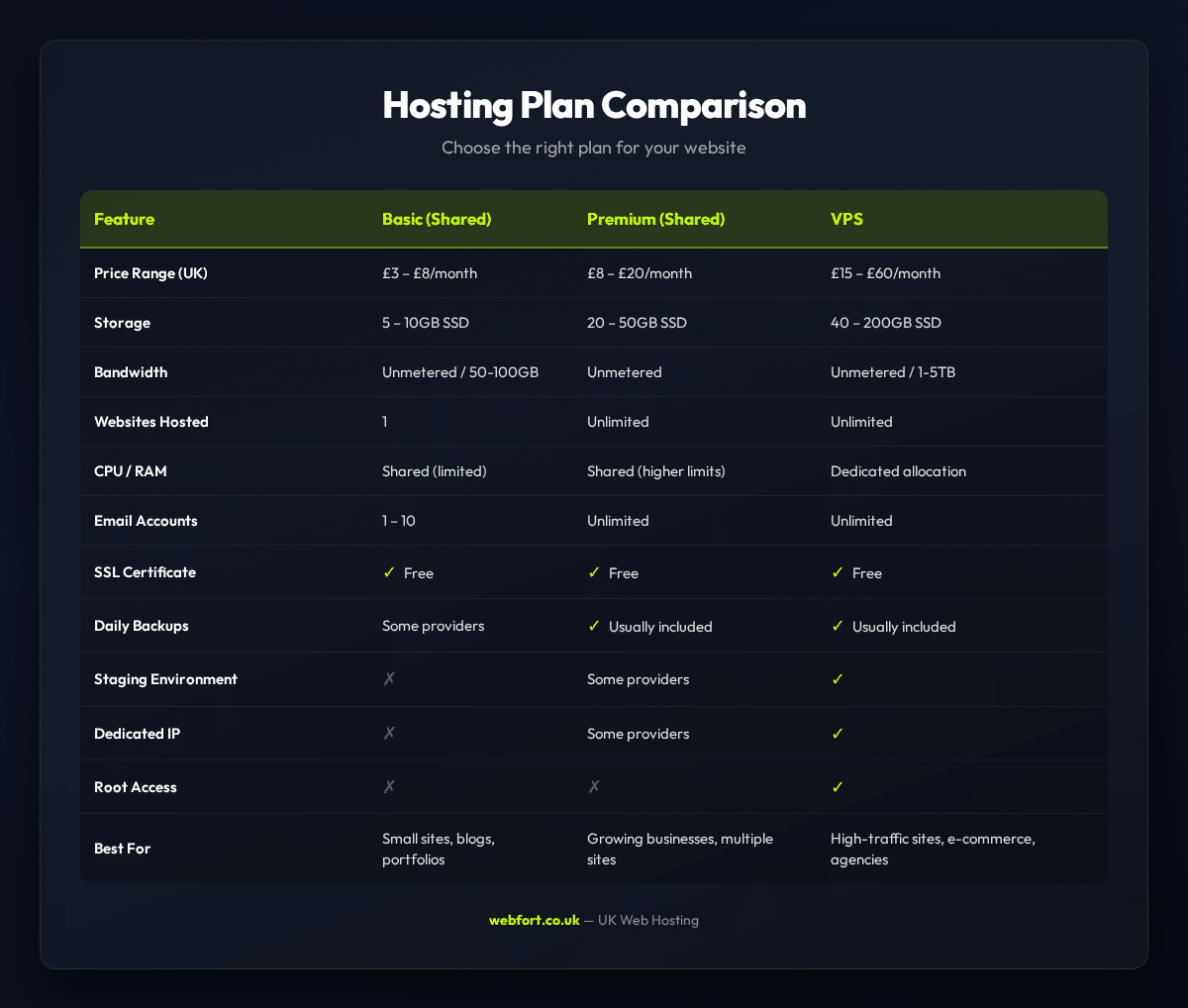
For most small business owners reading this, the Basic column is where you want to be. It covers everything you need without paying for resources you won’t use.
Frequently Asked Questions
Is basic hosting good enough for WordPress?
Yes, absolutely. WordPress is designed to run efficiently on shared hosting, and a basic plan with decent resources handles a standard WordPress site without issues. Most WordPress hosting for beginners starts on a basic shared plan. You only need to upgrade if you’re running a complex site with lots of plugins, custom functionality, or high traffic.
Can I upgrade later without downtime?
With most reputable hosts, yes. Upgrading from a basic to a premium plan usually takes minutes and doesn’t require any downtime. Your files and databases stay exactly where they are; the host simply allocates more resources to your account. Moving to a VPS may involve a migration, but good providers handle this for you.
What happens if I exceed my hosting limits?
This depends on your provider. Some will temporarily throttle your site’s performance (it loads more slowly but stays online). Others may suspend your account until you upgrade. At Webfort, we use CloudLinux LVE containers that limit resource usage per account, so your site slows down rather than going offline. We’ll also notify you so you can decide whether to optimise your site or upgrade your plan.
Is basic hosting secure?
Basic hosting can be perfectly secure, provided your host includes the right protections. Look for free SSL certificates, server-level firewalls, and regular software updates at a minimum. Some providers (including Webfort) include Imunify360 malware scanning even on basic plans. Beyond hosting, your own site security matters too. Keeping WordPress, plugins, and themes updated is just as important as your host’s security measures.
How many visitors can basic hosting handle?
A well-optimised site on a good basic hosting plan can comfortably handle 1,000 to 5,000 visitors per month. The exact number depends on your site’s complexity, how well it’s optimised, and your host’s resource allocations. If your pages are lightweight and properly cached, you might handle even more.
Do I need basic or premium hosting?
Start with basic if your site is new, has fewer than 10 pages, and you’re expecting modest traffic (under 5,000 visitors per month). Choose premium if you’re running multiple websites, an online shop, or a content-heavy site with thousands of monthly visitors. When in doubt, start basic and upgrade when you actually need to. There’s no point paying for premium resources if your site isn’t using them.
Final Thoughts
A basic hosting plan is enough for the vast majority of small websites. If you’re running a brochure site, a personal blog, a portfolio, or a simple landing page, you don’t need to spend £20+ per month on premium hosting. A solid basic plan with the right features will serve you well.
The key is choosing a provider that includes the essentials on their basic plan (SSL, backups, decent support, modern server technology) rather than stripping everything out to hit the lowest possible price point. Cheap hosting that leaves out backups or security isn’t a bargain; it’s a risk.
If you outgrow basic hosting, that’s a good problem to have. It means your site is growing. When that happens, upgrading is straightforward with a provider that offers a clear path from basic to premium to VPS.
At Webfort, our QuickStart plan at £4.99/month includes everything on this list and more. No renewal price increases, no hidden fees, and UK-based support whenever you need it. Start with our basic plan from £4.99/month and upgrade only when your site tells you it’s time.
2 comments
Comments are closed on this post.



[…] business website on shared hosting and want to make sure your whole setup is solid, our guide on choosing the right hosting plan is worth a read alongside […]
[…] you want a wider view of how reseller hosting compares to other account types, our guide to basic hosting plans covers the […]